arquitectura-architecture ( español/ english blog)

Friday, July 16, 2010

ESCUELAS , VIVIENDA SOCIAL Y COMUNIDADES

¿ Podemos ser mejores si tenemos un mejor ambiente físico que nos acoja?, esta pregunta ha dado vueltas por mi cabeza por un largo tiempo, y en síntesis plantea lo siguiente: si tenemos buenas condiciones de espacio físico bien diseñado para habitar, trabajar, estudiar, pasear, estar, etc. ¿ tenemos mayores posibilidades de ser mejores, en el amplio sentido de la palabra?.
Durante los pasados 14 años en Chile el estado impulsó programas para dotar a los colegio públicos de nueva infraestructura, nuevas escuelas, las cuales venían a solucionar viejos problemas de funcionalidad y dotación de nuevos recintos aptos para la educación. Me tocó participar en varios de estos proyectos , pero recuerdo uno en particular, una escuela que con una precaria infraestructura, acogía una población de niños provenientes de un entorno con problemas sociales complejos, Boca Sur en Concepción, y con los que se constituía una población estudiantil con muy bajos niveles de éxitos y con una convivencia diaria muy difícil. Luego de la reconstrucción de la escuela, poco o nada cambió, aún cuando se contaba con salas nuevas, nuevos baños, nueva biblioteca, nuevos comedores , etc.
Desde una visión macro, y de acuerdo a índices oficiales, los resultados de la política de mejoramiento de los programas educativos y su apoyo, los mejoramientos en las infraestructuras educacionales del llamado programa JEC, - en la cual se invirtieron muchos millones de dólares - , son decepcionantes, los indicadores de mejoramientos conocidos como prueba SIMCE o aún en la prueba de selección universitaria PSU, dan cuenta de resultados desesperanzadores , no revelan mejoras, más aún, indican que las brechas con sectores más acomodados de la sociedad, y que se educan en el sistema privado se ha incrementado , la diferencia es realmente importante, y aumenta.

En el caso de la vivienda social, me he preguntado lo mismo. El estado de Chile ha realizado gigantescos esfuerzos por dotar de viviendas a la población de más bajos ingresos del país, en el marco de cierta precariedad, se ha intentado llegar cuantitativamente con una viviendas de alrededor de 40 m2 para el mayor número de familias, tratando una hipotética familia típica, y así, en los últimos nueve años se han construidos un promedio de una 80.000 viviendas sociales de bajo estandar por año, y con ello el mapa de algunas zonas urbanas ha cambiado dramáticamente, el problema resulta aún mas complejo si se considera que se requieren aun unas 500.000 unidades más y al parecer viene más de lo mismo.
Las evaluaciones que han realizado numerosos estudios para verificar la situación del habitar en esas viviendas y en los conjuntos que se han formado han llegado a conclusiones preocupantes, nos encontramos con signos de deterioro social que va desde la segregación urbana hasta la estigmatización social. Con la fabricación de masiva de vivienda no sólo se ha creado un magma apto para el nacimiento de subculturas urbanas destructivas, sino que se han creado ambientes tóxicos para aquellas familias que tienen algún proyecto de vida y que habitan allí.

Podría, al igual que en el caso de las escuelas pensarse que se han subido algunos peldaños para el mejoramiento de las condiciones de vida de los chilenos, que somos mejores, pero me parece que se han bajado otros cuantos y definitivamente no somos mejores.


Un diseño de vivienda social mínima de 30 m2 , realizado por mi oficina con muy pocos recursos para su construcción, unos US $ 6000


Una escuela diseñada por mi oficina para un municipio local

Mi percepción es que las edificaciones nuevas, digamos arquitecturas nuevas, no ayudan a mejorar ambientes complicados o tóxicos y es más, en el caso de la vivienda social , se ha ayudado a cultivar en esos ambientes la malas potencialidades existentes. Los hechos lo demuestran.

¿ Que hacer ?, no creo que la solución vaya por la construcción de los espacios físicos, en el primero de los casos, la escuela , el problema radica en la familia, los niños son hijos de familias con problemas de drogadicción, analfabetismo, alcoholismo, monoparentalismo, etc, en el mejor de los casos, obreros de bajos ingresos siempre ausentes, en el segundo de los casos, el problema es similar, o el mismo, la escuela viene a ser sólo otro indicador del mismo problema que ocurre con el habitar en las poblaciones, así las obras físicas o de infraestructuras son sólo algo externo a los complejos problemas sociales y difícilmente ayudan a mejorar.

En mi opinión, la solución va por el lado de la educación, una educación que a mi juicio debe ser continua, no abandonarse nunca y en algunos casos, debe ser obligatoria aún para los adultos donde a mi juicio radica el problema. El ciudadano chileno medio esta perdiendo la batalla por la civilidad, siendo la educación el más significativo indicador, con unos 100 vocablos de promedio para comunicarse, no hay pensamiento profundo, no hay posibilidad para la cultura, no hay posibilidad para el desarrollo.

Con educación llega la cultura, con cultura el desarrollo personal, con el desarrollo personal los proyectos de vida, y con ello el desarrollo de la sociedad y la oportunidad para la arquitectura. Se equivoca nuestro presidente cuando dice que con mayor ingreso per cápita seremos desarrollados, una sociedad desarrollada es ante todo un conjuntos de ciudadanos desarrollados.

En otra apuesta complementaria , en el caso de la vivienda social, me parece que se puede ayudar algo al aumentar las superficies y predios mínimos , 40 m2 no acoge la familia y 60 o 100 m2 de terreno no albergan las necesidades de espacio exterior, hay una suerte de ahogo del habitar según los estándares chilenos, más ligado al campo que a la urbe. finalmente un ausente importante es el urbanismo, Chile no confía en el urbanista, no considera su opinión, no valora el pensar la ciudad.


Can we be better if we have a better physical environment that receives us?, this question has planted on my head in a long time and It is synthesized by the following matter: if we have good conditions of physical space adapted and designed well to live, to work, to study, to walk, to be, etc. Have we major possibilities of being better, in the wide sense of the word?.
During the last 14 years in Chile the condition stimulated programs to endow the public schools of new infrastructure, new buildings, which were coming to solve old problems of functionality and endowment of new suitable enclosures for the education. I had to take part in several of these projects, but I remember one case especially, a school that with a precarious infrastructure, there was receiving a population of children from an environment with social complex problems, Boca Sur in Concepcion, and with that a student population was constituted by very low levels of successes and by a daily very difficult conviviality. After the reconstruction of the school, little or nothing it changed, still when one was possessing new rooms, new baths, new library, new dining rooms, etc.
From a vision in perspective , and in agreement to official indexes, the results of the politics of improvement of the educational programs and his support, the improvements in the educational infrastructures of the program called “ JEC”, - in which many million dollars were invested-, they are disappointing, the indicators of improvements known in test for students like SIMCE or still in the test of university selection PSU, they show frustrating results, do not reveal improvements, even more, they indicate that the gaps with more well-off sectors of the society, and that are educated in the private system have been increased, the difference is really important, and increases.

In case of the social housing, I have asked myself the same thing. The government of Chile has realized gigantic efforts for providing with housings the population of more low income of the country, in the stage of certain precariousness, the government planning e has tried to come quantitatively with one housings of about 40 m2 for the major number of poor families,
Designing for a hypothetical typical family, in the last nine years there has been constructed an average of 80.000 social housings of low standard for year, and with it the map of some urban zones has changed dramatically, the problem proves still more complex if it thinks that approximately 500.000 units are needed even more and apparently more of the same thing comes.

The evaluations that have realized numerous studies to check the situation of to live in these housings and in the neighborhood that they have formed they have come to worrying conclusions, the authors think that signs of social deterioration that it goes from the urban segregation up to the social estigmatización. With the manufacture of massive of housing not only a suitable magma has been created for the birth of urban destructive subcultures, also a toxic environments have been created for those Hard-working families that have some project of life and that they live there.

It might, as in the case of the schools be thought that some steps have raised for the improvement of the conditions, that we are better, but it seems to me that others have stooped all those and definitively we are not better.

My perception is that the new buildings, we say new architectures, they do not help to improve complicated or toxic environments and it is more, in case of the social housing, one has helped to cultivate in these environments some bad existing potentials. The facts demonstrate it.

What to do?, I do not believe that the solution goes for the construction of the physical spaces, in the first one of the cases, the school, the problem takes root in the family, the children come from families with problems of drug addiction, illiteracy, alcoholism, one parent only, etc, at best case, workers with low income always absent, in the second one of the cases, the problem is similar, or the same one, the school comes to be only another indicator of the same problem that happens with to live in the populations, in this way the physical works on infrastructures or news buildings they are only slightly external to the complex social problems and difficultly they help to improve.

With education the culture comes, with culture the personal development comes, with the personal development the projects of life also comes, and with it the development of the society the opportunity for the architecture finally comes. Our president make a mistake when he says that with major index per capita we will be developed, a developed society or country is first of all a group of developed citizens.

In another complementary matter, in case of the social housing, it seems to me that it is possible to help a little on having increased the surfaces and minimal house, 40 m2 does not receive the family and 60 or 100 m2 of area do not shelter the needs of exterior space, a suffocation of the way to live according to the Chilean standards occurs , more near to the country live that to the city. Finally stay away important it is the urbanism, Chile does not trust in the town planner, does not believe his opinion, does not give value to think the city.

Tuesday, April 06, 2010

Terremoto y Arquitectura - Earthquake and Architecture

El reciente terremoto y tsunami del 27 de febrero pasado nos vino a recordar violentamente que en Chile, edificamos en un país sísmico.
Algunos proyectos que quisieron salir de la rigurosidad formal que impone una adecuada transmisión sísmica a través de las estructuras soportante, sufrieron las consecuencias, algunos se desplomaron y otros quedaron en muy mal estado.
Creo que los arquitectos chilenos, y en general aquellos arquitectos que actúan en países sísmicos como Chile, deben tener en su formación al menos dos aspectos diferenciadores importantes, conocer de estructuras con cierta profundidad, conocer de cómo estas se comportan bajo condiciones extremas, y saber sobre las características del suelo, más allá de las condiciones de la geotècnia, en la información de tipo geológica del área en que emplazarán.
Sin entrar en polémicas con la actual legislación chilena sobre el tema de la evacuación, parece importante que la evacuación en edificios de vivienda, entregue alternativas de evacuación abierta exterior, para un escape rápido o acceso de salvamento por el exterior. En muchos edificios que me ha tocado ver, esto no ha ocurrido, la única escala esta conectada a un pasillo oscuro, largo y cuyo único aspecto reconocible es el funcional, me imagino que escapar por un pasillo así, con intenso movimiento sísmico, sin electricidad y con la tabiquería reventàndose alrededor, debió ser espantoso.
Sin duda los arquitectos tenemos mucho que aprender de este terremoto, y habrán aspectos generales atingentes a la disciplina de la arquitectura que repensar, entre ellos, no dejar que las inmobiliarias influencien tanto el diseño, para ello se requieren sólidos argumentos que se deben aprender en las escuelas de arquitectura.


The recent earthquake and tsunami of last February 27 came to remember violently Us that in Chile, we build in a seismic country.
Some projects that wanted to go out of the formal rigor that a right imposes transmission seismic trough resistant structures , they suffered the consequences, they collapsed some and others stayed in very poor condition.
I believe that the Chilean architects, and in general those architects who are working in seismic countries as Chile, must have inside your formation plan at least two aspects different and important, to know about structures with certain depth, to know of these how they behave under extreme conditions, and to know on the characteristics of the soil, more there of the conditions of the geotechnical engineering, they need also the geological information to knowledge about and mitigation of natural hazards.
Without entering in discuss with the current Chilean legislation on the topic of the evacuation, it seems to be important that the evacuation in buildings of housing, delivers alternatives of opened outside evacuation ways, to escape from inside or access of rescue from outside. In many buildings that I have had to see, this has not happened, the unique stairway has been connected to dark corridor , long and which only one recognizable aspect is the functional , I imagine that to escape by kind of corridor like that, with intense earthquake, without electricity and with the non structural panel shooting down around, it should have been frightful.

Undoubtedly the architects we have much that to learn of this earthquake, and coming out other aspects itself of the architecture that to rethink, among them, not to allow that the real estate agencies should influence so much the design, for it we the architect needed strong arguments that must be learned in the schools of architecture.

Monday, August 24, 2009

Enseñanza de la arquitectura , un asunto complejo

Enseñanza de la arquitectura , un asunto complejo

Hace ya un tiempo que “ enseño” arquitectura en una prestigiosa universidad de Concepción, desde que comencé esta labor, he tenido cuestionamientos bastante profundo sobre el tema, he vagabundeado por Europa y América, peregrinando en la búsqueda de respuestas, camino que me ha llevado entre otras cosas a estudiar un postgrado en España.
Hay en la enseñanza de la arquitectura un tema central que me preocupa , las convicciones profunda de cada uno sobre que es arquitectura, que hace y como lo hace. Sobre el particular, he escuchado muchas respuestas, docentes amigos, arquitectos de prestigio, autores, y me he dado cuenta que cada cual tiene su convicción profunda sobre la cual fundamenta sus argumentos, lucha y trata de imponer su postura.
El otro tema es la evaluación, ¿ cómo es posible evaluar un trabajo de un alumno, si no entra en escena, la convicción profunda del docente sobre la arquitectura?, en esta línea me cuestiono que tan justo fui en las evaluaciones a los alumnos, ¿ como indagar si el resultado de sus esfuerzos, no es más que el calce en retroalimentación a mis convicciones profundas? , a veces siento la conformidad que siempre evalué ideas, si estas presentes hay arquitectura , esto me ha traído algunos desprestigio de colegas que envidiosamente me critican a mis espalda ante los alumnos, y alumnos que no entienden que las certezas en arquitectura se alcanzan al construir ellos mismos, su propio camino por la arquitectura por medio de sus propias ideas, si eso no ocurre, generaríamos clones de nosotros mismos, me parece triste.
En mi convicción, las certezas en arquitectura se alcanzan por medio del conocer la sociedad, el hombre, las relaciones que este establece, su forma de vivir, su cultura, sus expectativas ante su propia existencia, así me parece que la arquitectura viene a construir y consolidar en formas, espacios, relaciones y sensaciones , una forma de vivir propia de cada tiempo.


Education of the architecture, a complex matter

Already a time I am "teaching" architecture in Concepción's prestigious university, since I began this labor, have had questions deep enough on the topic, have wandered for Europe and America, peregrinating in the search of response, way that has led me to studying among other things a postdegree in Spain.

There is in the education of the architecture a central topic that worries me, the convictions deep of each one on whom it is an architecture, which it does and how it does. On the individual, I have listened too many answers, educational friends, architects of prestige, authors, and have realized that everyone has his or her deep conviction on which everyone bases your arguments, fight and tries to impose your position or attitude.

Another topic is the evaluation, how is it possible to evaluate a work of a pupil, if not enter on scene the deep conviction of the teacher about the architecture?, in this same line I itself have questioned that so just I do it in the evaluations to the pupils, because that I do not know with certainty if your investigation and project is the result of your own efforts and ideas, and not the answer to feedback to my own deep convictions?, sometimes I feel the conformity that always I evaluated ideas, if these ideas are present, then there is architecture, this has brought some colleagues' loss of prestige that enviously they criticize to my theirs theirs back before the pupils, And pupils who do not understand that the certainties in architecture are reached on having constructed they themselves, your own way for the architecture by means of your proper ideas, if it does not happen, we would generate clowns of us themselves, it seems to me to be sad.

In my conviction, the certainties in architecture are reached by means of know the society, the man, the relations that this one establishes, your way of living, your culture, your expectations before your own existence, this way it seems to me that the architecture comes to construct and consolidate in forms, spaces, relations and sensations, forms of living proper of every time

Tuesday, July 17, 2007

Arquitectura ¿ una singularidad?

Desde hace ya un tiempo vengo pensando este tema. En mi ensayo “ Hommo Arquitectónicus” que no se cuando voy a publicar, toco el tema en profundidad, en síntesis la idea me atrae y se las presento en alguno de sus aspectos.

La arquitectura definitivamente no puede tratarse sólo como arte, esta clara postura esta sustentada entre otros aspectos del análisis, en la idea del tiempo de comunicación con el hombre, el tiempo de comunicación en arquitectura es diferente al tiempo de comunicación de las artes en general, desde donde se analice el tema, la arquitectura esta en tiempos comunicativos diferentes a las obras de arte, entre otros, el tiempo de captura de los sentidos de una obra de arte es efímero, el de la arquitectura es sutilmente permanente.

La arquitectura no es ciencia : entre otros no es ciencia porque no puede levantar leyes basadas en la investigación fenoménica, aunque a mi juicio sí puede levantar teoría.

La arquitectura no es técnica : entre otros no es técnica por cuanto desecha sin más la metodología en su proceso más complejo e interno, la gestación de la idea ( sustento intelectual + parti). No es posible sostener que la idea es producto de un método, este nace bajo ciertos mecanismo internos ligados a las capacidades intelectuales de la creación humana ( una capacidad sorprendente), debidamente excitada.

La arquitectura no es un oficio como muchos tristemente sostienen, la arquitectura necesita de la teoría, de estudio teóricos que le permiten sustentarse en la elite intelectual y desarrollar sus paradigmas.

Al parecer, de las muchas líneas del conocimiento que desarrollo el hombre en la antigüedad, no todas se circunscriben hoy a las definiciones de las modernas disciplinas o campos de especialización, mi tesis es que la arquitectura tiene algo de diferente, tal vez si se piensa en la alquimia, o ciertos códigos hermenéuticos podrá entenderse mejor la idea.

Sostengo que la arquitectura es una singularidad, y tal vez entendiendo esto, podamos desarrollarla en la riqueza que potencialmente tiene, ello implica que se trata de un campo fértil para explorar y hacer florecer, comprenderla asociada a las artes, la ciencia, la técnica o desde el oficio, me parece estéril.

Architecture a singularity?

For a time I already come thinking this topic. In my rehearsal Hommo Arquitectonicus that I don´t know when I will publish it, I play the topic in depth, in synthesis I am attracted by the idea and I present them to him in some of its aspects.

The architecture cannot only be definded as art, this point of view is sustained among other aspects of the analysis, in the idea of the time of communication with the peoples, the time of communication in architecture is different to the time of communication of the arts in general, from anywhere that you can see the topic, the architecture is in talkative times different to the works of art, among other, the time of capture of the senses of a work of art is ephemeral but the time of the architecture is subtly permanent.

The architecture is not science: among other it is not science because it cannot lift laws based on the investigation of the physical world, although in my opinion it can lift theory.

The architecture is not technical: among other it is not technical since it discards without more the methodology in their more complex and more internal process, the gestation of the idea ( sustainable intellectual + parti). it is not possible to sustain that the idea is product of a method, this product is born under certain mechanism bound interns to the intellectual capacities of the human creation (a surprising capacity), properly excited.

The architecture is not (sadly some peoples said) an occupation, the architecture needs of the theory, of theoretical study that allow to be sustained in the intellectual elite and to develop your paradigms.

Apparently, of the many lines of the knowledge that was developed for the men’s in the antiquity, not all are bounded today to the definitions of the modern disciplines or specialization fields, my thesis is that the architecture has something of different, perhaps if one thinks of the alchemy, or certain hermeneutic codes it will be able to understand each other better the idea.

I sustain that the architecture is a singularity, and perhaps understanding this, we can develop it in the wealth that potentially has, it implies it that it is a fertile field to explore and to make get up, to understand it associated to the arts, the science, the technique or from the occupation, I find it sterile.

Wednesday, July 12, 2006

La integración espacial/ The space integration

La integración espacial

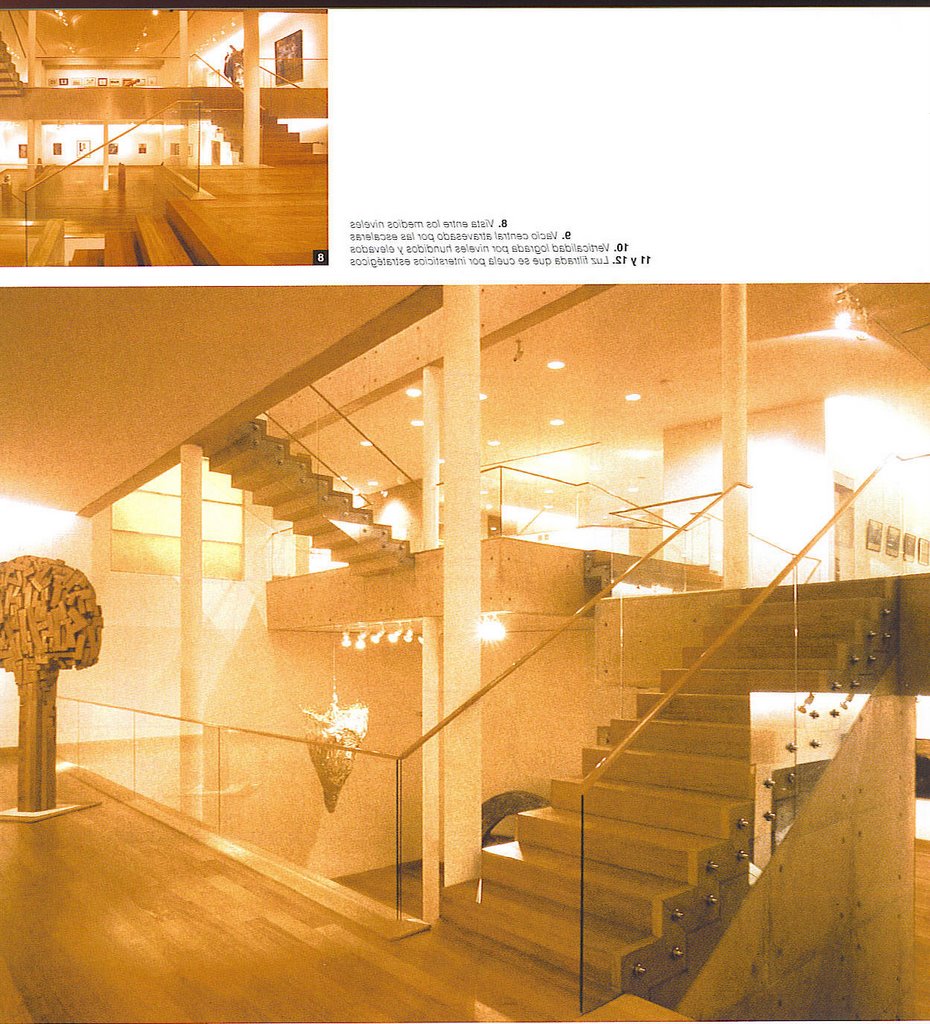
Si pensamos en una obra de arquitectura decimonónica, o de principios del siglo XX, es posible constatar que los recintos o espacios creados son claramente estancos, definitivamente cada recinto es una unidad espacial autárquica, probablemente conectada a un pasillo o un hall cumpliendo los requerimientos de conectividad funcional, no es hasta los años 1930 en que la integración espacial de nivel horizontal se encuentra en la obra de algunos arquitectos como Mies Van Der Rohe (pabellón de Barcelona).
Posteriormente esta idea evoluciona a la integración vertical, y los encuentros entre lo de arriba con lo de abajo se presenta como algo natural en arquitectura, así el límite entre espacios se virtualiza, se convierte en una idea de limite.


Cristian Undurraga – Museo de artes visuales Chile


Al parecer hoy la idea es la integración total, en todas las direcciones y en todo el espacio, de esa forma el límite se virtualiza aún más, y evoluciona a una estructura que requiere ser mentalmente comprendida, y que conceptualmente define el dominio visual, este complejo discurso espacial ocurre dentro los continentes o contenedores formales, que singularizan cada obra de arquitectura .

Por otra parte, el espacio exterior por la vía de los espacios interior – exterior viene a aportar aún más en esta idea, por cuanto se produce entre el adentro y el afuera, la integración espacial.
Creo que esto es un avance importante en la arquitectura contemporánea.

The space integration

If we think on a work of architecture since XIX century, or of principles of the XX century, it is possible to verify that the enclosures or created architectural spaces are clearly closed, definitively each enclosure is an autarchical space unit, probably connected to a corridor or a hall completing the requirements of functional connection, it is not until the years 1930 in that the space integration of horizontal level is in the work of some architects like Mies Van Der Rohe (pavilion of Barcelona).
Later on this idea, the vertical integration appear, and the encounters among that of up with that of below it is presented as something natural in architecture, this way the limit become a virtual thing, becomes an idea of it limits.


Apparently today the idea is the total integration, in all the directions and in the whole space, in that way the limit you even more virtual, and it evolves to a structure that requires to be mentally understood, and that conceptually it defines the visual domain, this complex space speech are inside the continents or formal containers that single each architecture work and show.

On the other hand, the external space for the road of the spaces inside - outside comes to contribute even more in this idea, so takes place between inside and the outside of the buildings, the space integration.
I believe that this is an important advance in the contemporary architecture.

Monday, October 31, 2005

The essence of the thing

El concepto de límite : El concepto de límite no es evidente en el discurso arquitectónico, no es posible rescatarlo de buenas a primeras. Excelentes intelectuales como Bruno Zevi(11), en su brillante exposición de la problemática de saber ver la arquitectura, al exponer el espacio en la médula de la arquitectura olvida este invitado ¿qué es el espacio sin límite? Los arquitectos son entre otros, maestros del límite, el concepto de límite subyace en la cosa misma y tiene la capacidad de subyugar la materia; el límite es la expresión real que permite la existencia misma de lo arquitectónico. El escultor español, Eduardo Chillida, aporta lo que a mi juicio resulta de una lucidez extraordinaria al exponer en su discurso relacionado con su obra ("el espacio es un misterio"), la idea que esculpimos el vacío con formas, esta aseveración cambia el punto gravitante en la idea de espacio, y levanta una forma de pensar sobre algo que siempre ha estado en la médula arquitectónica, la concepción del límite, una idea abstracta que en esencia es una herramienta de definición, la tinta del arquitecto.

De mi ensayo " La cosa misma"


The limit concept : The limit concept is not evident in the architectural speech, it is not possible to rescue him from the first hit. Excellent intellectuals such Bruno Zevi, in their brilliant exhibition of the problem of knowing how to see the architecture, when exposing the space in the marrow of the architecture he does forget this guest, but what is the space without limit? The architects are among other, master of the limit, the limit concept underlies in the same thing and it has the capacity to subdue the matter; the limit is the real expression that allows the same existence of the architectural thing. In my point of view the Spanish sculptor, Eduardo Chillida contributes with an extraordinary lucidity when exposing in his speech related with his work (the space is a mystery"), the idea that we sculpt the hole with forms, this asseveration changes the point of support in the space idea, and he lifts a form of thinking on something that has been always in the architectural marrow, the conception of the limit, an abstract idea that is a definition tool, the architect's ink in essence.

From my essay " La cosa misma" ( In english maybe : the essence of architecture)

Friday, October 14, 2005

hommo arquitectonicus

Quienes conocen de las etapas del proceso evolutivo, probablemente no recordaran haber visto u oído algo parecido al hommo arquitectónicus, quizás al oído de las palabras, algunos lectores pensarán que es un eslabón perdido de la cadena o algo relativo al pasado del hombre.

La tésis que desarrolla este escrito posiciona una perspectiva nacida de una reflexión personal entorno al hombre, se trata de una preocupación sobre el conocimiento del hombre contemporáneo en la disciplina de la arquitectura, y por lo tanto la óptica de análisis intentará ir más allá del típico discurso en aulas o seminarios que vincula la arquitectura con la condición humana sin más. Esta visión podría estar limitada y no exenta de perjuicios, sin embargo el objetivo es noble, se trata de intentar ayudar a identificar un tipo de hombre que pudiera no estar emparentado con el hommo sapiens, sin embargo para muchos arquitectos este individuo ocupa el lugar de privilegio que esta destinado a él , lo suplanta, se diría que en muchas oportunidades toma este las decisiones o las hace tomar por él, es algo así como el representante auto impuesto y plenipotenciario del hommo sapiens ... en lo arquitectónico .

Me parece una buena medida de higiene para la disciplina de la arquitectura buscar y denunciar algunos rasgos de este suplantador y reflexionar como evoluciona ( si es que lo hace) en paralelo a la realidad, necesidades y requerimientos humanos, saltándose los largos y a veces durísimos procesos por los cuales ha pasado el hombre real. El hommo arquitectonicus avanza de un estadio a otro con singular prestancia, esta presente en el pensamiento arquitectónico contemporáneo y con toda seguridad lo estuvo ayer, todo indica que esta hecho para que perdure, es inmortal, es un superstar.

....de mi ensayo " Hommo arquitectonicus"...

Who know of the stages of the evolutionary process, they didn't probably remember to have seen or heard something similar to the hommo arquitectónicus, maybe to the hearing of the words, some readers will think that it is a lost link of the chain or something relative to the man's past. The thesis that develops this writing positions a born perspective from a reflection personal environment to the man, it is a concern on the contemporary man's knowledge in the discipline of the architecture, and therefore the analysis optics will try to go beyond the typical speech in classrooms or seminars that it links the architecture with the human condition without more. This vision could be limited and it doesn't exempt of mistakes, however the objective is noble, it is to try to help to identify man's type that could not be related with the hommo sapiens, however for many architects this individual occupies the privilege place that this dedicated to him, it supplants it, it would be said that in many opportunities taking this the decisions or he makes them take for him, it is something like that as the representative imposed car and plenipotentiary of the hommo sapiens... in the architectural thing. I find a good measure of hygiene for the discipline of the architecture to look for and to denounce some features of this supplanter and to meditate like it evolves (if it is that he makes it) in parallel to the reality, necessities and human requirements, being jumped the long and sometimes hard processes by which the real man has happened. The hommo arquitectonicus advances from a stadium to another with singular excellence, this present in the contemporary architectural thought and with all security it was he yesterday, everything indicates that this fact so that it lasts, it is immortal, it is a superstar...


...from my essay " Hommo arquitectonicus"

Wednesday, October 05, 2005

¿ Es importante la arquitectura para nosotros? / Is important the architecture for us?

Intentar explicar “el por qué” la arquitectura aparentemente no ha alcanzado una relevancia más sólida que su sola existencia, y por lo tanto es cuestionable, no entendible e intrascendente para muchas personas, puede llevar a un campo de respuestas que no gustan en absoluto en el mundo disciplinar, respuestas que hablan de problemas no resueltos, de cadenas decimonónicas vinculadas a los procesos formativos de los arquitectos, de lo incomprensible del lenguaje arquitectónico, y otros aspectos ocultos. Por ello, y para evitar el bulto, tal vez la respuesta más simple sea alguna hipótesis vinculada a la incomprensión social de las artes, pero ¿qué barreras existen entre la arquitectura disciplinar y la sociedad? ¿ hay realmente lazos que involucren el quehacer disciplinario con el individuo social actual?. Aquel ciudadano anónimo, ajeno a la arquitectura antigua, ajeno a los patrimonios formales, a la arquitectura de postal, al desconstructivismo de Lebinskind, lejos de los libros especializados, ¿cuánto le importa realmente la arquitectura?.

....... de mi ensayo " La importancia del paraguas "


To try to give a explanation to " why" the architecture seemingly has not reached a more solid relevance that its single existence, and therefore it is questionable, not understandable and with not importance for many people, it can take to a field of answers that it don't like at all to discipline, answers that speak of non resolved problems, of old chains linked to the formative processes of the architects, of the incomprehensible of the architectural language, and other hidden aspects. For it, and to avoid the bundle, is the simplest answer perhaps some hypothesis linked to the social incomprehension of the arts, but what barriers do they exist among the architecture to discipline and the society? are there really strong links that involve the disciplinary chore with the current social individual?. That anonymous citizen, unaware to the old architecture, unaware to the formal patrimonies, to the postcard architecture, to the desconstructivism of Lebinskind, far from the specialized books, how much does he really care the architecture?.

from my essay " The importance of the umbrella"

Tuesday, August 16, 2005

Architecture-arquitectura


Hola, este es mi blog, aqui espero convocar opiniones sobre la arquitectura y el urbanismo, lo haré simulatáneamente en español e inglés hasta donde pueda.
Me interesa la arquitectura, soy arquitecto y creo que tengo ideas sobre este tema, además me gustaría contactar arquitectos del mundo para hablar sobre ella
Mi primer acercamiento a este tema es mi convicción que la arquitectura esta perdiendo campo en el mundo entero, se esta reduciendo su importancia y me parece que los grandes maestros no estan contribuyendo al pensamiento como lo hicieron otros de antaño

Hi, this it is my blog, here I hope to summon opinions about the architecture and urbanism, I will make it simulataneosly in Spanish and English until I can. It interests me the architecture, I am an architect and I believe that I have ideas on this topic, I would also like to contact architects of the world to talk about her
Well my first approach to this topic is my conviction that the architecture this losing field in the whole world, I think it are reducing its importance and I find that the big master are not contributing to the thought like they made it others master in the past.